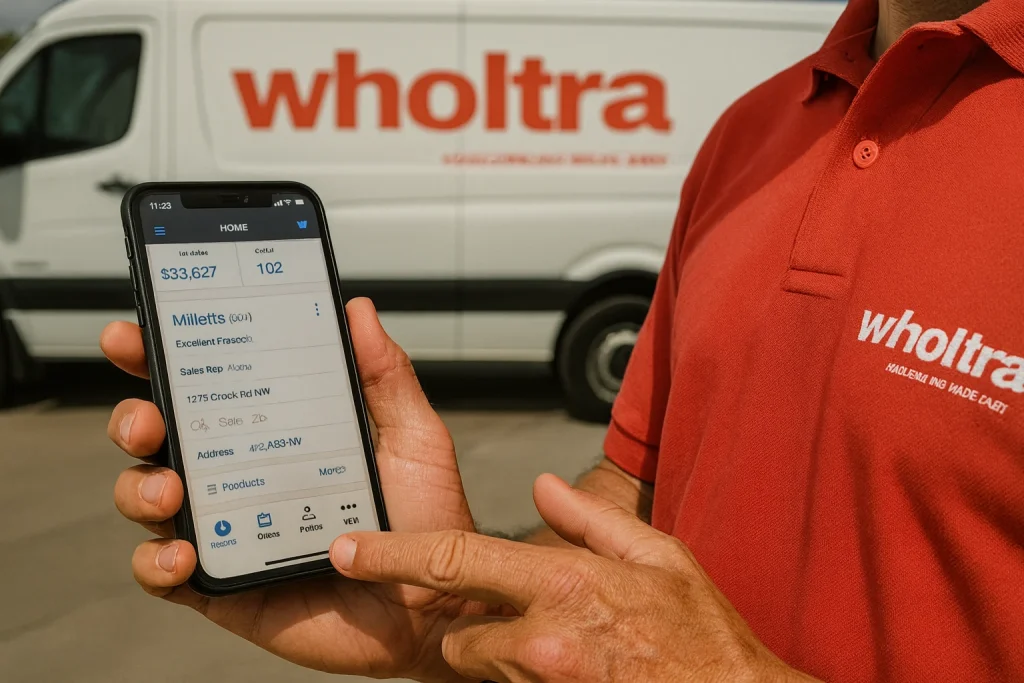
What to know about mobile sales app requirements field reps
Navigating North American wholesale markets involves managing diverse infrastructures and regulatory environments that often clash within a single distribution network. When you build your sales team, you likely want to move as fast as possible across state lines or provincial borders. However, trying to use one generic app configuration for the entire continent can lead to costly data compliance failures down the road. Whether you are distributing beverages in Texas and Ontario, managing food inventory from coast-to-coast, or supplying hardware stores nationwide, understanding mobile sales app requirements field reps is critical before your team goes live.
Wholtra exists as an all-in-one wholesale distribution management platform designed to simplify these exact complexities. Our goal is helping distributors manage customers, orders, inventory, invoicing, deliveries, and payments from one easy-to-use system so you can spend less time managing logistics and more time growing the business. But for any leader looking at a cross-border deployment strategy, there are distinct differences in how field representatives operate when they step into Canadian provinces versus United States states that must be addressed immediately.
In this guide, we will break down exactly what your sales operations team needs to consider regarding hardware compatibility, platform configuration, data privacy laws like PIPEDA and CCPA, and ERP integrations specific to the North American market. By understanding these distinctions, you can ensure a smooth rollout of mobile sales app requirements field reps that supports growth without creating administrative headaches later on.
Hardware Compatibility for Field Representatives Operating Cross-Border
One common misconception in wholesale distribution is assuming that “one OS fits all.” While Android and iOS dominate the mobile market globally, the infrastructure supporting them differs across North America due to carrier restrictions and network reliability issues specific to certain regions. A representative using a tablet might rely on cellular data while traveling through rural counties or remote industrial parks where Wi-Fi signals are sparse.
Connectivity Standards: US States vs Canadian Provinces
In Canada, roaming agreements can sometimes be more restrictive than those in the United States depending on the carrier used by your employees’ personal phones versus company-owned tablets. You must ensure that mobile sales app requirements field reps checklist includes connectivity testing for specific rural areas or remote sites where you service customers regularly.
For example:
- United States: 5G coverage is dense in most commercial hubs, but certain states still rely on legacy LTE networks which might throttle high-speed data transfers if the device isn’t optimized correctly by a carrier plan.
- Canada: Many provinces utilize distinct network frequencies that require different radio frequency bands for optimal performance than those found exclusively in US equipment.
When configuring your sales app repository, avoid storing sensitive customer lists on devices without secure cloud encryption enabled over cellular data. While the core device hardware is largely universal (iPhones and Android tablets), you must enforce a standardized OS version to minimize support tickets regarding carrier lock requirements for roaming data vs Wi-Fi reliance in specific areas.
Configuring Platform Settings: Currency, Language, and Units
Trying to run US Dollars ($) versus Canadian Dollars ($CAD) without clear logic inside your backend is the number one cause of reconciliation errors at month-end. If a rep enters an order while on patrol, does their system automatically convert pricing? No—it should respect your business rules unless specific multi-currency protocols are active.
Managing Mixed Units
While most distributors rely on imperial units (pounds) for US customers and metric units (kilograms) elsewhere—though this overlap is actually common due to trade agreements—you must configure the platform so that inventory tracking remains accurate regardless of which warehouse ship dock the rep visits from in mobile sales app requirements field reps guide.
Language Nuances
Canada has a bilingual population, particularly within Quebec and Ontario. While your business logic might not need French language toggles enabled for every screen, it is wise to ensure you aren’t violating local accessibility standards or expectations if servicing specific retail partners there. Your configuration should allow rep selection of the interface preference per region without breaking global inventory data integrity.
Compliance: Data Privacy and Security Protocols
This section addresses legal requirements that can dismantle a deployment strategy before launch begins. When your reps access customer contact information in Alberta, you must be prepared to handle PIPEDA (Personal Information Protection and Electronic Documents Act) differently than when they are handling the same data under CCPA (California Consumer Privacy Act).
What Ongoing Maintenance Schedules Are Required
What ongoing maintenance schedules are required to ensure app version consistency while navigating varying data storage regulations in both regions?
You cannot deploy a software update globally at once if it changes how encryption keys are handled for different jurisdictions. You must schedule specific “compliance windows” where your team audits stored logs against local laws during deployment rollout. This ensures that you do not accidentally store Canadian PII (Personally Identifiable Information) on servers physically located in states with stricter retention requirements or vice versa, which can happen if a cloud provider misconfigures data centers automatically for cost-saving reasons.
Security Protocols
Are there specific security protocols mandated for cross-border inventory access that must be configured separately during field representative rollout? Yes. Cross-border sales often involve moving product from Canadian distributors to US retailers or vice versa (via third-party logistics). Accessing this shared inventory requires separate authentication configurations if the goods are being sold in two distinct tax jurisdictions with different audit trails. Your IT team should verify that your app uses multi-factor authentication that supports both regions seamlessly without creating friction for field reps trying to log in via corporate credentials while on a sales route outside their home province or state.
Payments and ERP Integration
Integrating payment gateways is where technical hurdles often become operational bottlenecks during deployment strategies, especially if you are processing credit card payments directly from mobile devices used by your staff rather than backend invoicing terminals for some clients.
Payment Gateways: Linking Order Data Across Borders
What ongoing maintenance schedules are required to ensure app version consistency while navigating varying data storage regulations in both regions? (Referenced earlier, but also applicable here). When linking mobile order data from Canadian distributors with US counterparts during deployment steps like this one—especially when using a liquidation inventory software—you must verify that the payment gateway API supports distinct currencies if you are consolidating invoices for wholesale partners who accept payments in both CAD and USD.
Some distributors prefer to keep transactions separate per region, while others use Wholtra’s system to consolidate multiple invoices into one payment link for wholesale distributors with connected invoice tracking which simplifies this significantly. If your business model involves selling liquidation inventory online or bulk items across borders, you might need specific tax compliance features configured that differ from standard food and beverage sales where sales taxes like PST/HST are critical in Canada but less complex in many US states depending on the item type (taxable goods vs exempt).
Deployment Strategy: How to Choose Your Requirements
Choosing mobile sales app requirements field reps near United States locations or within Canadian provinces is a strategic decision, not just an IT one. It involves your operational workflow as much as it does code. Here are actionable tips for choosing the right setup for your specific distribution business model (whether floral wholesalers, beverage distributors, snack and candy suppliers):
Pre-Launch Setup Checklist
When you move forward with a mobile sales app requirements field reps checklist strategy review before hitting deploy button in production environment:
- [ ] Verify carrier roaming restrictions on employee devices.
- [ ] Configure currency conversion rules (USD vs CAD).
- [ ] Audit data retention policies against local laws (CCPA/PIPEDA/GDPR).
- [ ] Ensure inventory modules handle cross-border logistics tracking correctly.
If your team is currently managing spreadsheets or disparate systems to track these differences, you are risking losing sales opportunities due to slow order entry times. Wholtra simplifies this by offering a bulk inventory ordering system that integrates directly into the workflow of field representatives regardless of where they draw their next stop map route on their mobile device navigation apps tied back up your warehouse network for delivery dispatch instructions matching fulfillment requirements automatically so invoices match pickup tickets seamlessly during checkout process at end-of-shift.
Common Mistakes During Rollout
A major issue we see is ignoring the mobile sales app requirements field reps cost over time in terms of training and support, rather than just upfront licensing fees. Cross-border teams require more robust IT support because they encounter a wider range of device models or network conditions (e.g., Wi-Fi dead zones on rural farm-to-table routes vs high-speed city center connections). Do not underestimate the hidden maintenance costs if your deployment strategy relies heavily on manual troubleshooting for field reps stuck in traffic with slow internet access where real-time data sync fails and customer orders sit pending overnight until next day morning shift resets server connection backlogs properly cleared.
